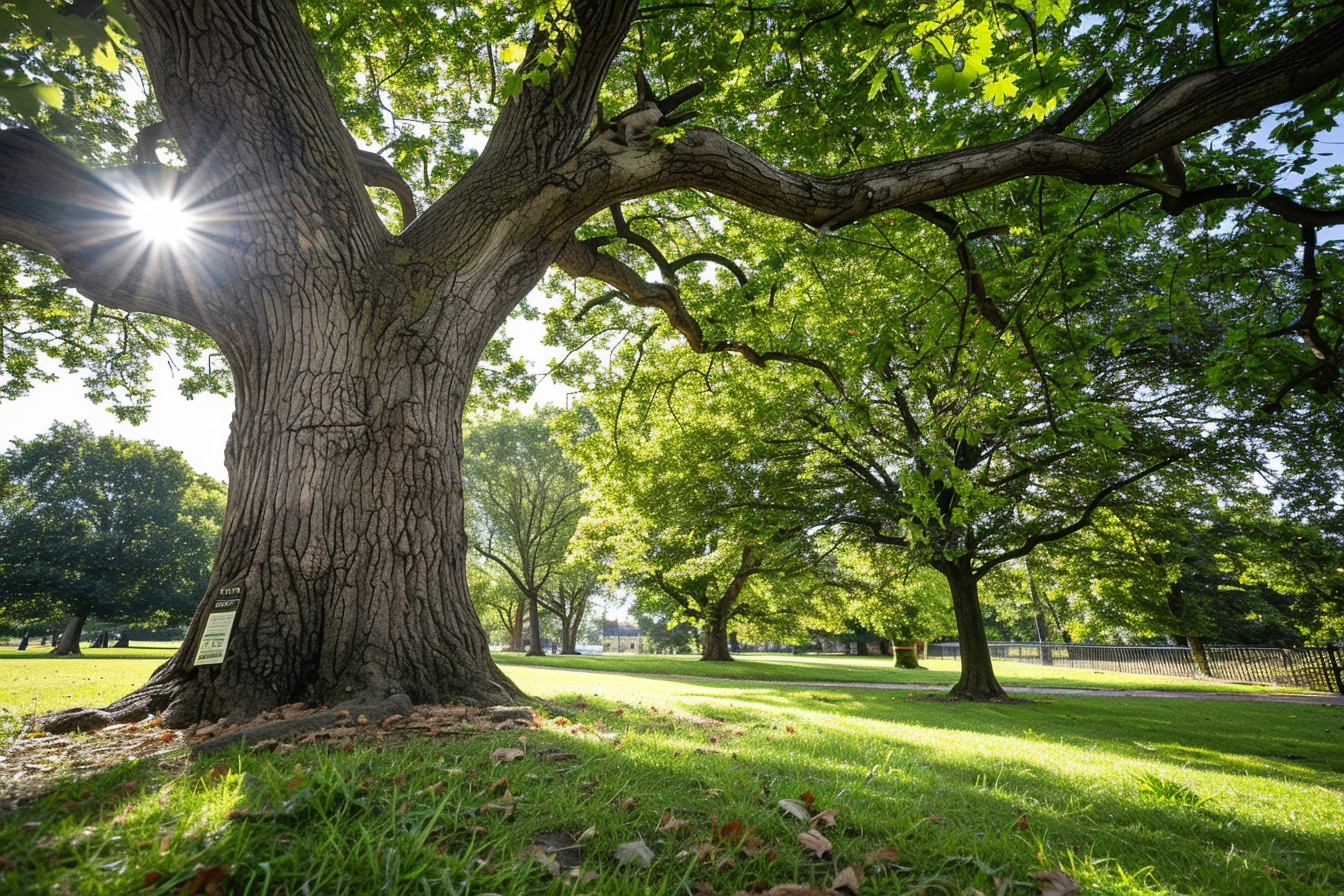
Crown reduction is a precise, regulated form of pruning in which the overall height and spread of a tree’s canopy is carefully reduced – achieved by cutting branches back to suitable lateral growth points whilst preserving the tree’s natural shape and long-term structural integrity. For mature oak trees in London’s dense urban environment, it is not an optional or cosmetic treatment. It is a scheduled, professional intervention that manages structural risk, supports long-term tree health, and keeps homeowners on the right side of planning law. From the veteran oaks of Victoria Park to the mature specimens rooted in private gardens across Poplar, Limehouse and Bow, East London’s ageing tree canopy depends on this kind of skilled, cyclical care to stay safe, healthy and standing for generations to come.
What Crown Reduction Actually Involves
More Than Just “Cutting It Back”
One of the most persistent misconceptions in domestic tree care is that crown reduction and tree topping are broadly the same thing. They are not – and the distinction matters enormously for both tree health and professional compliance.
Topping – sometimes called lopping – involves removing large sections of the crown indiscriminately, leaving oversized stubs, exposing raw wood to decay and destroying the tree’s structural form. It is widely condemned across the arboricultural profession and should never be applied to a mature oak.
Crown reduction follows British Standard BS 3998:2010, the UK benchmark for tree work. Every cut is made back to a suitable growing lateral – a secondary branch with sufficient diameter to assume the growth role of the removed stem. The result is a canopy smaller in height and spread that nonetheless retains the tree’s natural silhouette, remains structurally balanced and continues to function as a healthy organism.
It is also worth distinguishing crown reduction from two related techniques commonly used on urban trees. Crown thinning selectively removes branches from within the canopy to improve light penetration and air movement without altering overall dimensions. Crown lifting removes the lower limbs to raise the base of the canopy – useful near roads, footpaths and buildings. Crown reduction addresses overall volume and, for a large, mature urban oak, is typically the most significant of the three interventions.
Why Oak Trees in Particular Require This Work
The Biology of a Slow-Growing Giant
London’s parks, streets and private gardens support significant populations of both English oak (Quercus robur) and sessile oak (Quercus petraea) – two of Britain’s most ecologically important native species. Both are long-lived, slow-growing and capable of developing enormous, architecturally complex crowns over many decades. This is precisely what makes them so impressive – and, without careful management, potentially hazardous in a densely built environment.
As a mature oak ages, its lateral limbs extend outward under their own increasing weight. This creates end-weight loading, where the furthest extremities of each branch carry a disproportionate gravitational load, placing cumulative stress on branch unions. Oaks are also particularly susceptible to included bark – a structural defect that occurs when two co-dominant stems grow in close proximity, trapping bark tissue between them and creating a weak, splitting-prone union.
In managed woodland, veteran oaks self-regulate through natural limb shedding. In an urban garden, that same process becomes a liability. A substantial limb falling without warning onto a rooftop, parked vehicle or pedestrian is not an abstract possibility – it is a foreseeable consequence of unmanaged end-weight loading in a tree that has passed its last intervention window.
What Urban Stress Does to a Mature Oak
London’s oaks face pressures that their woodland counterparts do not. Compacted soil from foot traffic, construction activity and impermeable surfacing restricts root development and limits access to water and nutrients. Urban heat island effects – particularly pronounced across the densely developed residential and commercial areas of East London – intensify summer drought stress considerably. Air pollution, artificial lighting and physical disruption from utility works all add further cumulative strain.
Under sustained stress of this kind, a tree’s compartmentalisation response – its natural mechanism for isolating and walling off damaged or infected tissue – becomes progressively less effective. Pruning wounds take longer to occlude. Decay establishes more readily. A stressed urban oak managed on an irregular or reactive basis will deteriorate visibly faster than a comparable tree maintained on a consistent professional programme.
Why Every 5–7 Years Is the Professional Standard
The Growth Cycle and the Window of Intervention
The 5 – 7 year cycle for crown reduction on mature urban oaks is not an arbitrary convention. It reflects the actual rate at which secondary growth on a correctly reduced crown reproduces the structural conditions – end-weight loading, co-dominant stem competition, increased sail effect in high winds – that the previous reduction was carried out to address.
Within approximately five years of a well-executed reduction, the lateral growth produced at each pruning point will have extended sufficiently to warrant reassessment. By year seven in an actively growing urban specimen, that secondary growth is typically recreating the original problem at scale. Intervening within this window keeps each reduction modest in scope, minimises the volume of wood removed in any single session and significantly reduces the physiological stress placed on the tree.
Waiting beyond that window – or acting only after storm damage has already occurred – reverses every one of those advantages. Emergency works following storm damage are more expensive, more disruptive and considerably more traumatic for the tree. A documented management history, built consistently from one cycle to the next with the same qualified contractor, is one of the most valuable long-term investments a tree owner can make.
Crown Reduction and the Law – What London Homeowners Must Know
TPOs, Conservation Areas and the London Borough Rules
Tree work in London is governed by a legal framework that regularly catches homeowners by surprise – particularly across East London, where Tree Preservation Orders (TPOs) and Conservation Area designations are both widespread.
A TPO is a statutory protection placed on an individual tree or group of trees by the local planning authority. In the London Borough of Tower Hamlets – covering Poplar, Limehouse, Bow and surrounding areas – TPOs are actively applied to significant specimens on both public and private land. Carrying out crown reduction on a TPO-protected tree without prior written consent from the council is a criminal offence, carrying fines of up to £20,000 or an unlimited penalty where the tree is seriously damaged or destroyed.
Trees within a Conservation Area require a minimum 28-day written notification to the local planning authority before any work begins. The council may use this period to inspect the tree and impose a TPO if it considers this appropriate. A reputable East London tree surgery contractor will carry out both a TPO register check and a Conservation Area verification as standard, managing any required application or notification on your behalf.
What to Expect From a Professional Crown Reduction in East London
From Initial Survey to Final Clearance
A professional crown reduction on a mature oak is a structured, multi-stage process – and understanding what it involves helps homeowners plan realistically around access, timescales and cost.
The process begins with an initial site survey, during which a qualified arborist assesses the tree’s overall health, identifies structural concerns such as deadwood, decay or co-dominant stem formations, and determines the appropriate reduction specification. This is also the stage at which any required planning consent or Conservation Area notification is identified and prepared.
The works typically require a team of two to three experienced tree surgeons, specialist rigging equipment to control the descent of heavy crown sections, and – in the constrained gardens and tight terraced streets of East London – careful prior planning around access, pavement licences and neighbouring property boundaries. In areas like Poplar and Limehouse, where rear gardens are often compact and site access passes through the property, the logistical demands are considerable and form a meaningful part of the overall scope of works.
On completion, all arisings – timber sections and chipped brash – are cleared from site. A professional contractor will provide a written summary of the works, note any observations about ongoing tree condition and recommend a return date for the next assessment, keeping the management record current and properly maintained.
Signs Your Oak May Be Overdue a Crown Reduction
What to Look For Before You Call
You do not need to be a tree surgeon to recognise when a mature oak may be approaching – or past – its reduction window. The following are the most reliable indicators that a professional assessment is overdue:
- Heavy lateral limb extension beyond the natural crown line, particularly on branches overhanging rooftops, boundary walls or public footpaths
- Visible deadwood in the upper crown – dry, brittle stems carrying no foliage, often with bark loss along their length
- Previous pruning wounds that have failed to occlude, or that show signs of discolouration, fungal growth or soft, decayed wood at their margins
- Noticeable sail effect during high winds – significant rhythmic canopy movement suggesting the crown mass has grown beyond what the root plate can comfortably anchor
- A formal notification from Tower Hamlets Council, a neighbouring property or a utility company regarding overhanging or encroaching branches
Any single one of these is sufficient grounds for arranging a professional assessment. The right time to act is before the next storm season – not after it.
Conclusion
Crown reduction, carried out correctly and on schedule, is one of the most effective tools available for keeping London’s mature oaks safe, healthy and standing. It is skilled, regulated, cyclical work – not a one-off job – and the 5 – 7 year cycle exists for sound biological and structural reasons that compound in value the more consistently they are followed.