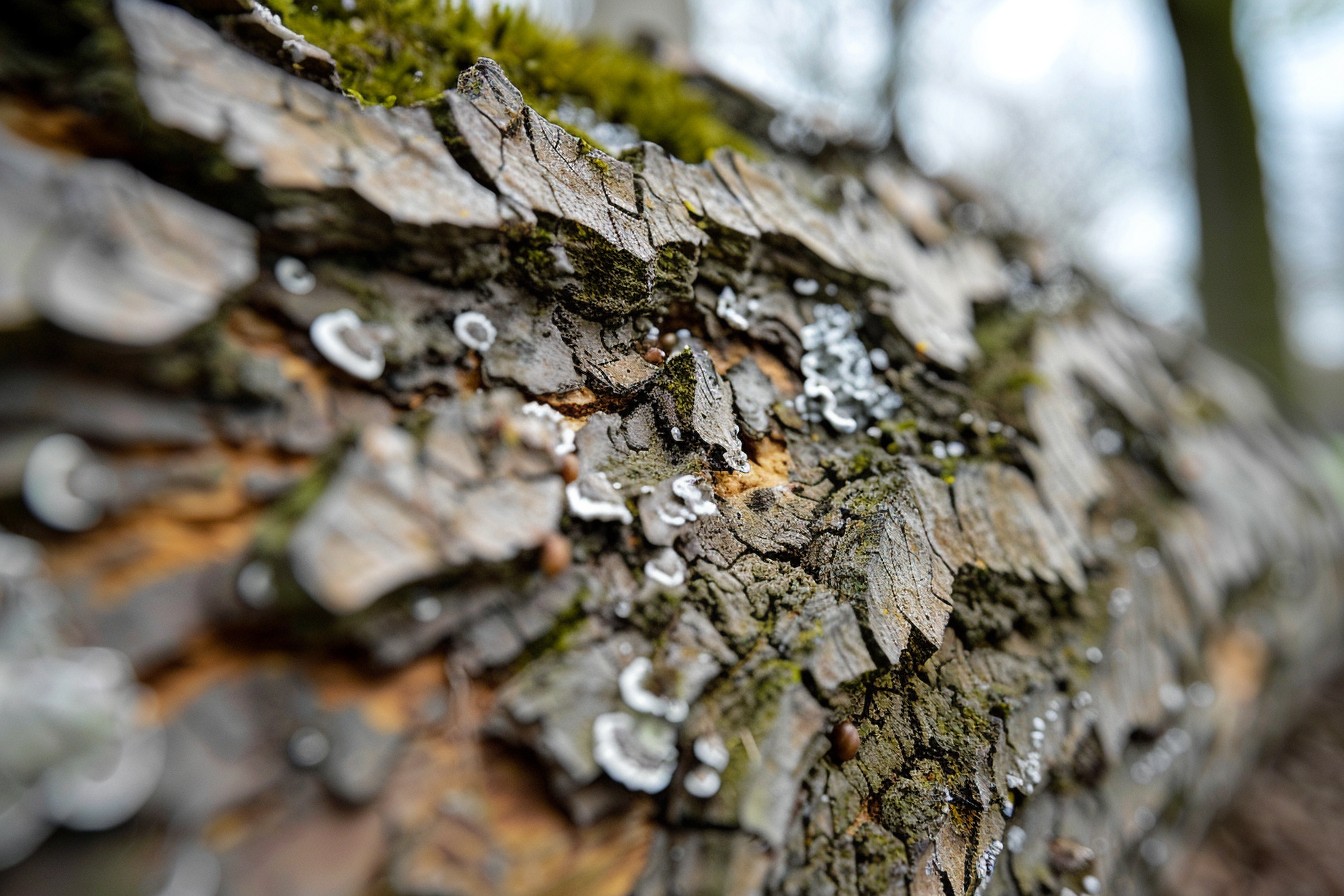
You are deadheading roses on a Sunday morning when you notice it – a shelf-like, pale-edged growth jutting from the base of your garden oak. It was not there last autumn. It is substantial, layered and oddly architectural, and it has appeared seemingly overnight. Is it dangerous? Does the tree need to come down? Should you remove it before it spreads?
Bracket fungi are among the most visually striking and most widely misunderstood features of tree health assessment. The anxiety they provoke in homeowners is understandable, but it is not always proportionate – and, in the opposite direction, a degree of complacency about certain species can have genuinely serious consequences. Some bracket fungi are devastating indicators of advanced structural decay that places people and property at risk. Others are far less urgent. The ability to distinguish between the two is not merely academic – it is the difference between a measured, professional response and either unnecessary removal of a healthy tree or a dangerous failure to act.
What Bracket Fungi Actually Are
The Fruiting Body Is Only Part of the Story
What you see on the trunk or at the base of a tree is not the fungus itself. It is the fruiting body – the reproductive structure, equivalent in function to a mushroom above ground – produced by a fungal organism whose mycelium has already been colonising the internal wood tissue of the tree, often for several years before the bracket becomes visible.
By the time a bracket erupts through the bark, the decay it represents is already established. The mycelium will have been breaking down wood cell structure from within, progressing along the grain of the timber in ways that are entirely invisible from outside. The bracket’s sudden appearance does not mark the beginning of the problem – it marks a point at which the problem has matured sufficiently to reproduce.
Understanding which tissues a given fungal species targets is central to risk assessment. Fungi that primarily colonise heartwood – the dense, non-living central core of the trunk – cause decay that progresses more slowly and leaves a residual shell of functional sapwood that can, depending on thickness, maintain structural integrity for a considerable period. Fungi that attack sapwood, root tissue or the root collar are considerably more serious, as these are the systems responsible for water and nutrient transport, and for anchoring the tree in the ground.
The High-Risk Species – Brackets That Indicate Structural Failure
Ganoderma Species – The Most Common Serious Threat in Urban Gardens
For East London tree surgeons, Ganoderma species represent the most frequently encountered high-risk bracket fungi across residential properties. Ganoderma adspersum and Ganoderma australe are both large, woody and perennial – building new layers of tissue each year, with a hard, brown-crusted upper surface, a cream to white pore layer on the underside and a distinctive tendency to leave brown spore deposits on surrounding surfaces. They are most commonly found at the base of the trunk or associated with surface root tissue.
The decay mechanism is white rot – a process that breaks down both lignin and cellulose simultaneously, leaving affected wood soft, pale, fibrous and wet. Unlike some forms of decay that progress slowly within a contained zone, white rot caused by Ganoderma can advance extensively through the root system and lower trunk, hollowing out the structural base of the tree whilst the crown above continues to look perfectly healthy. A tree may retain full leaf cover and apparent vigour right up to the point of basal failure.
Discovery of any Ganoderma species at the base of a garden tree should be treated as a prompt for immediate professional assessment. Do not wait for visible crown decline – it may not arrive before the tree does.
Meripilus giganteus – The Giant Polypore and Root Decay
The giant polypore is immediately recognisable when it appears – large, overlapping, fan-shaped brackets in tones of buff, tan and brown, typically clustered at the base of the trunk or, critically, emerging from the soil surface above buried root tissue some distance from the stem. This root-zone emergence pattern is one of the most diagnostically significant features of Meripilus giganteus: it tells you that the decay is not confined to the visible base of the tree but may be tracking through the root plate.
This species causes a white rot targeted at the root system and root collar – the structural anchor of the entire tree. Affected roots lose tensile strength and become progressively unable to resist the lateral loading imposed by the crown in wind. The particular danger of Meripilus is that it can render a tree genuinely windthrow-prone whilst the above-ground portions show minimal symptoms. Crown health is not a reliable indicator of root integrity in affected specimens.
Meripilus giganteus is particularly associated with beech and oak, both of which are well represented in East London gardens and street tree populations. If you find it, a professional assessment – including root plate inspection and, in most cases, a resistograph test – is not optional.
Laetiporus sulphureus – Chicken of the Woods and Its Structural Implications
There is no bracket fungus in the British Isles more immediately arresting than Laetiporus sulphureus. Its vivid sulphur-yellow and orange brackets, erupting in large overlapping shelves from the trunk or major limbs, are genuinely unmistakeable at any time of year. On oak – by far its most common host in East London – it causes a brown rot, a decay mechanism quite distinct from white rot in its structural implications.
Brown rot degrades cellulose whilst leaving a modified residue of lignin in place. The result is wood that fractures in a characteristic cuboid, cracking pattern – dry, brittle and prone to sudden, catastrophic failure rather than the gradual, progressive softening associated with white rot. Trees affected by brown rot heartwood decay do not always give visible warning before structural failure. For large, mature specimens with significant crown spread over gardens, buildings or public space, this failure mode demands serious attention and a formal risk assessment.
Lower-Risk Species – Brackets That Warrant Monitoring But Not Alarm
Grifola frondosa – Hen of the Woods
Grifola frondosa – hen of the woods – produces a distinctive rosette of overlapping, grey-brown tongue-shaped brackets at the base of oak trees, typically in late summer and early autumn. It is associated with a white butt rot that causes genuine internal decay, but its progression tends to be slower and more localised than that of Ganoderma or Meripilus. A tree with hen of the woods present is not necessarily in immediate structural danger – but it should not be ignored. Annual monitoring and a periodic professional assessment every two to three years is a proportionate and prudent response.
Inonotus hispidus – The Shaggy Bracket
The shaggy bracket is a relatively common find on ash and mature apple trees in East London gardens – two species well established across residential properties in Tower Hamlets and surrounding boroughs. Its large, spongy brackets in rust-orange to deep brown tones typically emerge on the main trunk, often at some height above ground level, and exude a dark liquid as they age.
Inonotus hispidus causes a white rot localised to the zone of infection rather than a systemic decay, which limits its structural impact compared to the root-zone species. The risk it represents is, however, position-dependent. Found near a major branch junction or scaffold limb, the localised decay it causes at that point can create a genuine failure risk for the affected limb. Found on the mid-trunk well clear of major unions, it is considerably less immediately concerning. Location, as with all bracket species, is inseparable from the risk assessment.
Why Location on the Tree Changes Everything
Base, Trunk, Crown – Reading the Bracket’s Position
Species identification is a necessary starting point, but it is not sufficient on its own. Where a bracket appears on the tree fundamentally shapes the nature of the risk it represents.
Brackets at the base or associated with surface roots signal potential compromise of the root plate – the system that keeps the tree anchored. Root plate failure gives very little warning and tends to result in whole-tree windthrow. This is the failure mode with the greatest consequence for surrounding property and public safety, and it justifies the most urgent professional response.
Brackets on the mid-trunk indicate internal decay at a specific cross-sectional point. The structural significance depends entirely on how much sound wood remains – a question that visual inspection alone cannot reliably answer and that requires diagnostic tools to assess properly.
Brackets in the upper crown or on secondary limbs indicate localised branch decay. This is the most manageable scenario and is often resolvable through targeted pruning, removing the affected limb to a sound lateral whilst retaining the rest of the tree.
What a Professional Assessment Involves
Beyond Visual Identification – Tools and Methods Used by Qualified Arborists
A qualified tree surgeon assessing a bracket-affected tree has access to a diagnostic toolkit that extends well beyond visual identification. The resistograph is a drill-based instrument that advances a fine needle through the wood, measuring resistance as it goes – decay columns appear as zones of dramatically reduced density, revealing the extent of internal compromise in a way the naked eye cannot. For larger specimens, sonic tomography and the Picus system allow three-dimensional mapping of decay within the trunk, producing a cross-sectional image of sound and compromised wood without invasive cutting.
Crown assessment, root plate inspection and soil assessment around the base of the tree complete the picture. The outcome of a thorough survey is a formal written report – one that documents the tree’s condition, quantifies the risk and, where required, supports a planning application to the local authority for consent to carry out any recommended works. For TPO-protected trees in Tower Hamlets and across East London, this documentation is both a professional and a legal necessity.
What Homeowners Should Do Immediately After Discovering a Bracket
Don’t Remove It – and Don’t Ignore It
The two most common mistakes homeowners make on discovering a bracket fungus are, unfortunately, opposites. The first is to remove it – knocking it off the tree or cutting it away in the belief that this will halt the decay or make the tree safer. It will do neither. The mycelium responsible for the internal decay is unaffected by removal of the fruiting body, and the bracket’s absence will simply deprive the assessing arborist of the most immediate diagnostic evidence available.
The second mistake is to do nothing, on the basis that the tree looks fine, the bracket is small or a neighbour has one too. Size and crown appearance are not reliable indicators of structural integrity in a fungus-affected tree.
The correct response is straightforward. Photograph the bracket from multiple angles, note its precise position on the tree – base, trunk, root zone or crown – and record any associated symptoms you can observe, such as crown thinning, dead branches, soil heave or soft ground near the base. Then contact a qualified tree surgeon promptly. Where the tree is covered by a TPO, professional documentation of its condition is also relevant to any subsequent consent application.
Conclusion
Bracket fungi demand informed, species-aware assessment – neither panic nor dismissal. The margin between a tree that can be safely retained and managed and one that represents a genuine structural risk to people and property often comes down to correct species identification, accurate positional analysis and the right diagnostic equipment in trained hands.