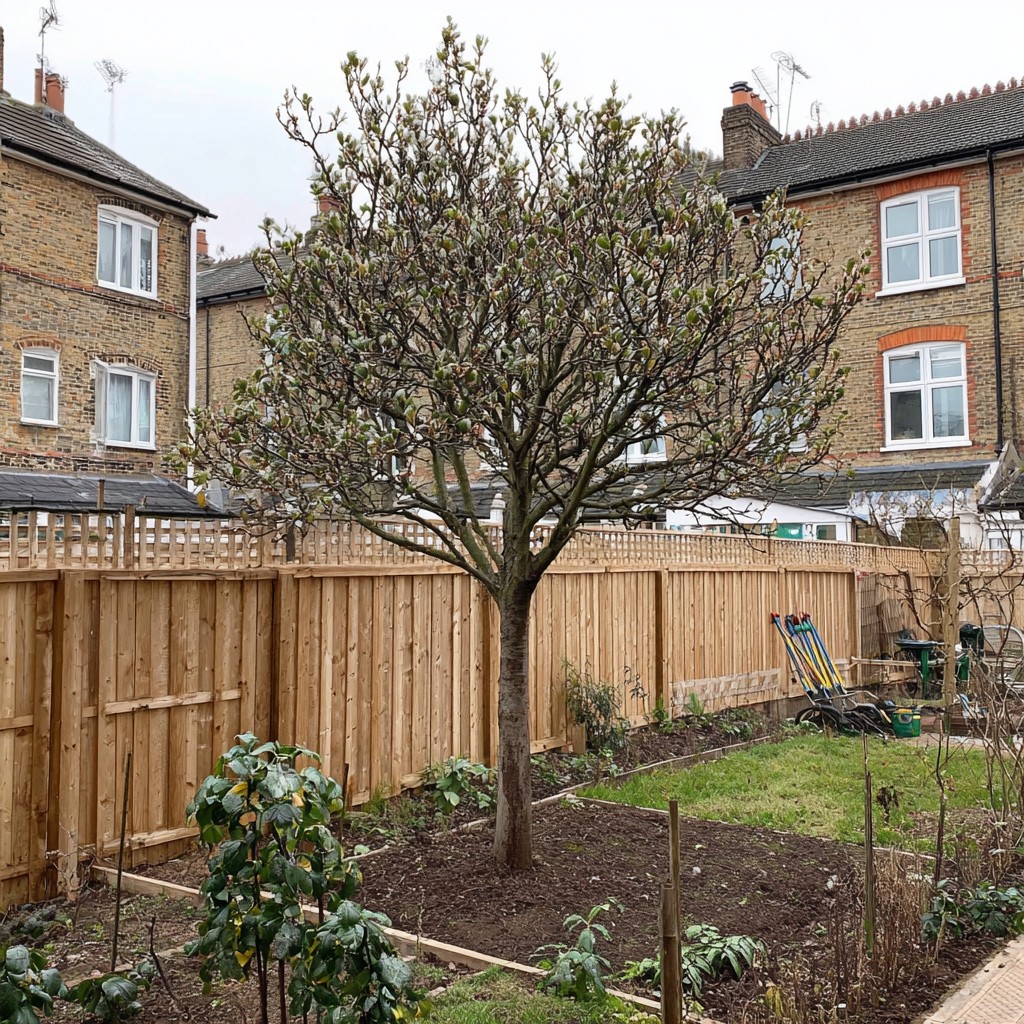
Plant a tree today and the work most people imagine – crown reductions, deadwood removal, structural assessments – feels like a distant concern. The tree is young, the growth is vigorous and the problems associated with mature urban specimens seem a long way off. This is precisely the thinking that creates those problems in the first place.
The structural character of a mature tree is not determined in its middle age. It is determined in its earliest years, when the architecture of the crown is still being established, when the hierarchy of stems and scaffold limbs is still negotiable and when the interventions required to influence that architecture are small, precise and relatively inexpensive. Formative pruning is the discipline that makes those early interventions count – and for young trees establishing themselves in the particular pressures of a London urban environment, it is one of the most valuable investments a tree owner can make.
What Formative Pruning Is – and What It Is Not
Intervention at the Right Stage
Formative pruning is the practice of making carefully considered, light-touch pruning cuts to a young tree during its early years of establishment, with the explicit objective of developing a sound, balanced and structurally resilient crown architecture. It is not remedial work. It is not a response to an existing problem. It is a proactive programme applied during the window when structural decisions are still relatively easy to influence – before poor form becomes entrenched and before the removal of a problematic stem means removing a substantial portion of the established crown.
The distinction matters because it changes the logic of when to act. Most tree maintenance is reactive – a tree develops a problem, the problem becomes visible, a tree surgeon is called. Formative pruning inverts that model entirely. The best time to correct a co-dominant stem is when it is a finger-width in diameter, not when it has grown to the girth of a forearm. The best time to establish a clear central leader is in year two, not year twelve. The costs and consequences of intervention scale directly with the size of the material being removed, and early action keeps both to a minimum.
Why the First Five Years Are the Critical Window
The Biology of Early Structural Development
A young tree in its first years of growth is, in physiological terms, doing something remarkable. It is allocating resources – carbohydrates, water, growth hormones – across a rapidly expanding network of stems and branches, establishing dominance hierarchies, responding to light availability and competing with surrounding vegetation for space. The structural patterns laid down during this period have a strong tendency to persist and amplify as the tree matures.
The apical meristem – the primary growing tip at the top of the central leader – produces auxins that suppress the lateral growth of competing stems immediately below it. This hormonal dominance is what maintains a single, straight leading stem in well-structured young trees. Where the central leader is damaged, browsed, or simply outcompeted by a vigorous lateral, that dominance is lost. Two or more stems of roughly equal vigour begin to compete for vertical dominance, producing the co-dominant stem formations that are among the most common – and most consequential – structural defects in mature urban trees.
Within the first five years, these patterns are still malleable. Competing stems can be subordinated or removed whilst the wounds are small and the tree’s compartmentalisation response is at its most effective. After year five, the window does not close, but the interventions required to achieve the same outcomes become progressively more significant.
The Key Objectives of Formative Pruning
Central Leader, Scaffold Limbs and Branch Spacing
A sound formative pruning programme is guided by a small number of clear structural objectives that apply, with species-specific variation, to the majority of young amenity trees.
The establishment of a single, dominant central leader is the primary goal for most upright-growing species. This provides the vertical structural axis from which the permanent scaffold limbs – the main branches that will form the framework of the mature crown – radiate at appropriate intervals. The spacing and radial distribution of these scaffold limbs determines whether the mature crown will be balanced and wind-resistant, or asymmetric and prone to structural loading in one direction.
Formative pruning also targets the removal of crossing branches, which create rubbing wounds and points of bark damage that provide entry points for fungal decay. It addresses downward-growing branches that will eventually conflict with the crown’s usable space, and – particularly in street and garden tree contexts – begins to establish the crown clearance height appropriate to the tree’s location. Early removal of competing shoots from the lower stem, whilst retaining temporary lateral growth that assists trunk development, is a technique that builds stem taper and structural strength in ways that later pruning cannot replicate.
Common Structural Problems That Formative Pruning Prevents
Co-dominant Stems, Included Bark and Crossing Branches
The structural defects most commonly identified in mature London trees – the ones that generate tree surveys, risk assessments, expensive crown work and, in the worst cases, emergency removals – have their origins, almost without exception, in the unmanaged early years of the tree’s development.
Co-dominant stems, as noted above, develop when two or more stems of approximately equal vigour compete for the apical position. As both thicken, the union between them tightens, trapping bark tissue in a formation known as included bark. Unlike a conventional branch union, which develops a strong interlocking wood collar, an included bark union grows progressively weaker relative to the load it bears. In a large, mature tree subject to wind loading, it is a point of potential catastrophic failure. Identified in a two-year-old tree, it is resolved by a single cut. Identified in a twenty-year-old tree, it may require a crown reduction, a cable-bracing installation or, where the risk is unacceptable, removal of a major structural limb.
Epicormic growth – vigorous, weakly attached shoots arising directly from the trunk or main branches – is another persistent problem in unmanaged young trees, particularly in species such as lime and cherry. Left to develop, epicormic shoots compete with the primary crown structure and produce a congested, poorly formed canopy. Removed whilst young, the intervention is trivial. The same principle applies to basal shoots, water shoots at major pruning wounds and competing leaders arising after tip damage.
Species-Specific Considerations for London’s Most Common Young Trees
Oak, Lime, Plane and Cherry – Different Habits, Different Priorities
Formative pruning is not a generic prescription. The structural tendencies of different species vary considerably, and an effective programme is tailored to the natural growth habit of the individual tree.
Young oaks are relatively forgiving in early development but have a strong tendency to produce multiple competing leaders from the upper crown. Early selection and subordination of competing stems – retaining the strongest, most vertically dominant shoot and reducing rivals – is the single most important formative intervention on a young Quercus. Left unaddressed, the multi-stemmed oak crowns common across East London’s parks and residential streets are the direct result.
Lime trees – both common lime (Tilia x europaea) and small-leaved lime (Tilia cordata), both widely planted in Tower Hamlets and surrounding boroughs – are prolific producers of basal and stem epicormic growth. Regular removal of this material in the early years keeps the structural form clean and reduces the long-term maintenance burden considerably.
London plane, the city’s most numerous street tree, develops a strong natural structure but benefits from early crown lifting and the establishment of a clear stem height appropriate to its location. Young cherries and ornamental Prunus species have a tendency toward narrow, ascending branch angles that can develop into included bark formations – early intervention to select well-spaced, wider-angled scaffold limbs pays significant dividends at maturity.
Formative Pruning in the Urban Context – London’s Specific Challenges
Soil, Space, Light and the Pressure of the Built Environment
Young trees establishing in London’s urban environment face a set of pressures that amplify the value of good formative management considerably. Restricted soil volumes in tree pits and compacted urban soils limit root development and reduce the vigour available to the crown, meaning that structural problems which a more vigorously growing tree might partially self-correct can become entrenched more readily.
Light availability in East London’s densely built residential streets – particularly in the terraced housing stock of Poplar, Bow and Stepney – is frequently uneven, driving asymmetric crown development in young trees planted close to buildings or boundary walls. A young tree reaching strongly toward available light will develop a lopsided scaffold structure that becomes increasingly difficult and costly to manage as the crown matures. Formative pruning that anticipates and partially corrects this tendency – selectively subordinating the most aggressively phototropic growth whilst supporting structural balance – produces far better long-term outcomes than waiting for the problem to fully establish.
Urban soils also support a range of pathogens and physical stressors that make pruning wound management particularly important. Cuts made to young trees in a dense urban environment should always follow sound arboricultural practice – clean, collar-preserving cuts that support rapid occlusion and minimise the period during which open wood is exposed to airborne fungal spores.
What a Formative Pruning Programme Should Look Like
Annual Assessment and Light-Touch Intervention
The most effective formative pruning programmes are not single interventions – they are annual or biennial assessments combined with genuinely light-touch work. The goal at each visit is not to transform the tree’s structure in one session but to make the smallest possible correction that keeps development on the right trajectory.
In practical terms, this means an annual walk-around assessment from a qualified arborist in the tree’s first two to three years, identifying any competing leaders, crossing branches or structural anomalies that warrant attention. The pruning work arising from these visits – on a healthy, well-sited young tree managed proactively – should be modest in scope and rapid in execution. It is only when assessments are skipped and problems are allowed to compound that the interventions required become significant.
The return on this investment is not felt in year one or year three. It is felt in year twenty, when a structurally sound mature tree requires a routine crown reduction rather than an emergency structural assessment, and when the people and property beneath it are not at risk.
Conclusion
The mature trees that define London’s green canopy – the oaks in its parks, the planes along its streets, the cherries in its residential gardens – did not acquire their form by accident. Where they are structurally sound and well-proportioned, the chances are good that someone made considered decisions about their development early on. Where they are problematic, co-dominant, congested or hazardous, the roots of that condition almost invariably lie in the unmanaged years of early growth. Formative pruning is not a luxury for young trees in the urban environment – it is the foundation on which every subsequent decade of management either builds or struggles.